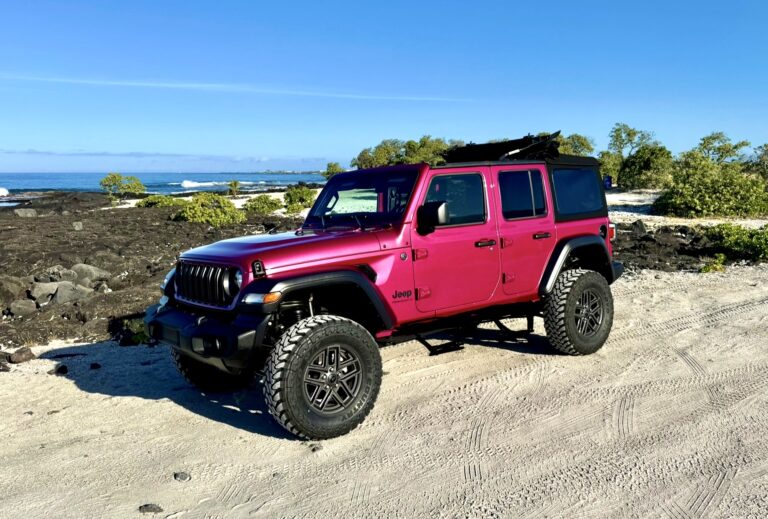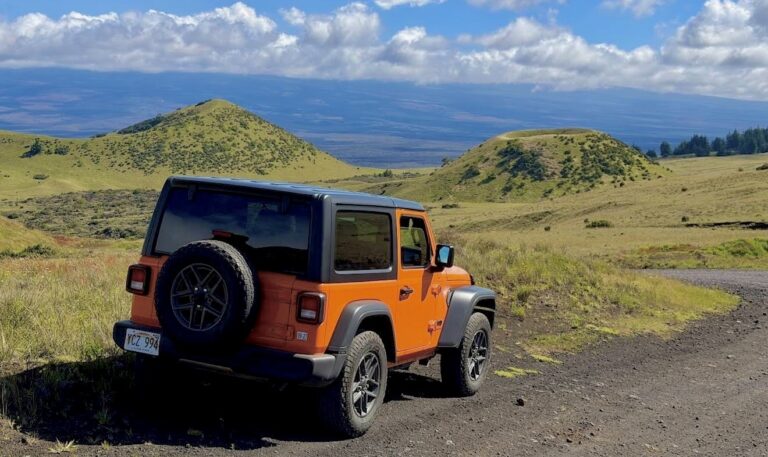
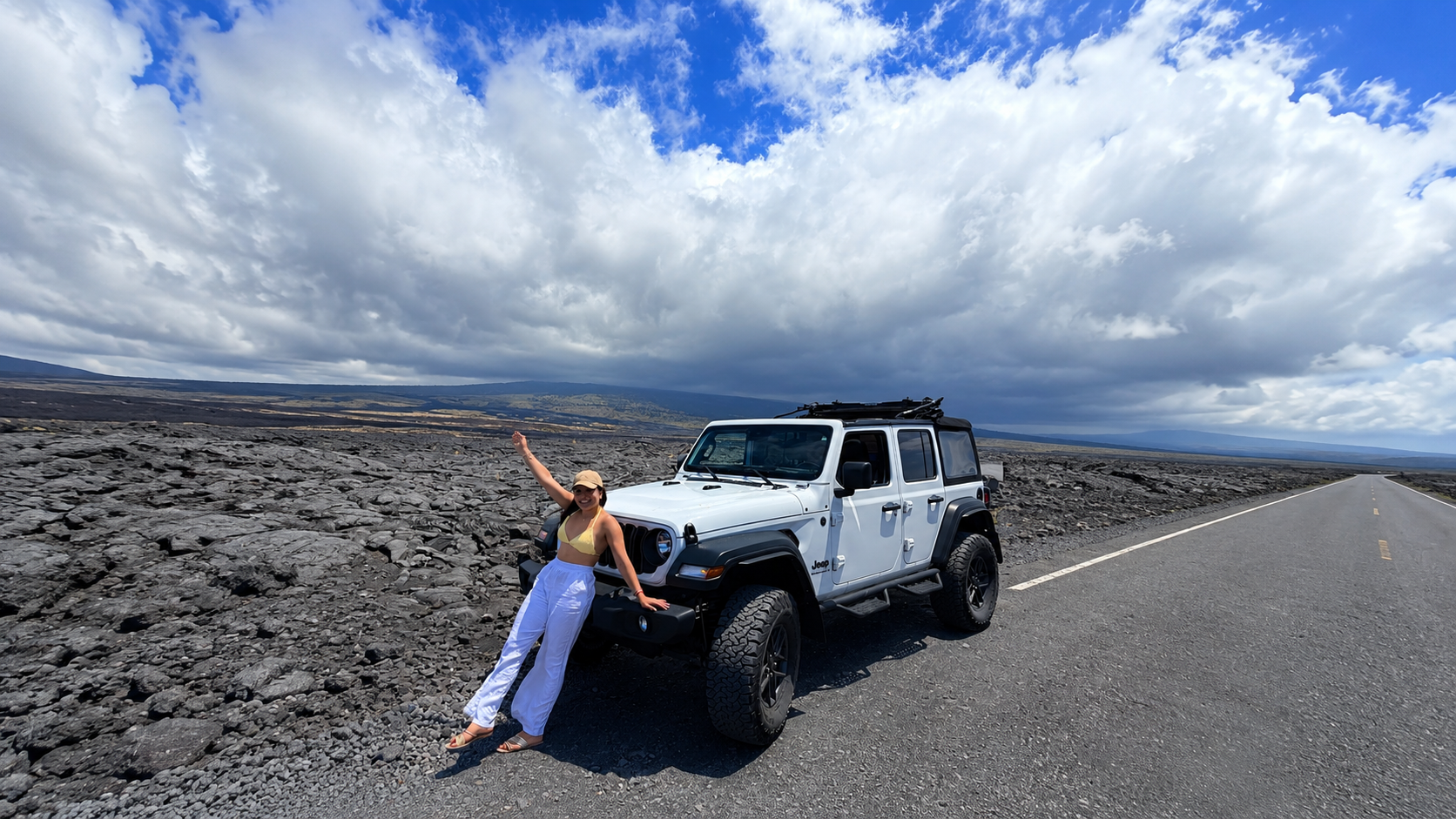
The Big Island of Hawaiʻi is unlike any other place on earth. You’ve got active lava fields, snow-capped volcano summits, black sand beaches, rainforests, and high-desert terrain — sometimes all within a single day’s drive. A standard rental car will get you from the airport to the resort. A Big Island Jeep rental will get you everywhere else. This guide covers everything you need to know before booking your Jeep rental on the Big Island — from choosing the right vehicle and understanding road conditions, to what’s actually worth the detour and how to make the most of every mile.
Why a Regular Rental Car Won’t Cut It on the Big Island
Most visitors land in Kona, pick up a sedan, and spend their trip on the highway corridor between resorts. That’s fine — if you’re happy staying on the pavement. But the Big Island rewards the curious, and a lot of its best spots require more than a compact car.
Roads That Demand 4WD
The Saddle Road (Daniel K. Inouye Highway) cuts straight across the island between Mauna Kea and Mauna Loa. At elevations above 13,000 feet, Mauna Kea’s summit road is steep, unpaved, and often icy. Most standard rental companies explicitly prohibit their vehicles on this stretch — and void your coverage if you go anyway.
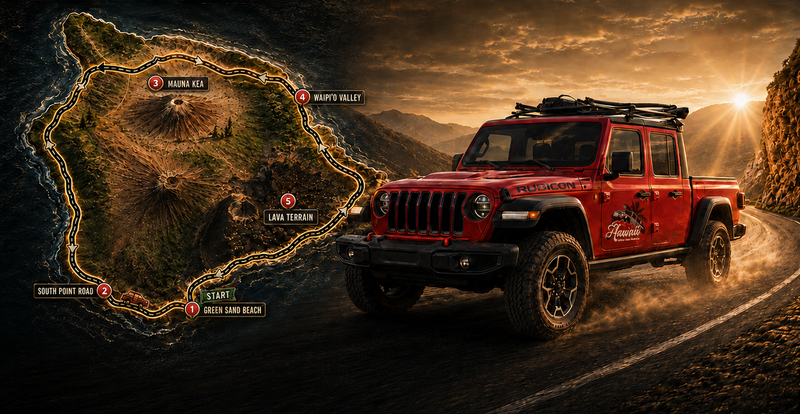
Then there’s South Point Road, the route to Green Sand Beach (Papakolea), which involves a 2.5-mile stretch of rough lava rock that will bottom out a sedan. Waipio Valley Lookout offers one of the most dramatic views on the island, but descending into the valley itself requires serious ground clearance.
A lifted Jeep rental on the Big Island handles all of it — legally, safely, and without the anxiety of wondering if your transmission is going to survive the descent.
What to Look for in a Big Island Jeep Rental
Not all Jeep rentals are equal. Here’s what actually matters when you’re booking for a Hawaiian road trip:
1. 4WD-Low Capability
Standard 4WD handles most situations. But for Mauna Kea’s summit road or loose lava terrain near Volcano National Park, 4WD-Low is a different level of control. Make sure your rental is actually capable of it — not just marketed as “4WD.”
2. Lift Height and Tire Size
A stock Jeep Wrangler is decent. A lifted Wrangler with 33–35″ tires is built for what the Big Island actually throws at you. Look for at least a 1.5″ lift and all-terrain tires if you’re planning serious off-pavement driving.
3. Seating and Luggage Capacity
Traveling with family? A 4-door Wrangler fits 5 passengers and holds up to 4 large suitcases. If you need more cargo space, a Jeep Gladiator with a truck bed and tonneau cover gives you people room without sacrificing gear.
4. Convertible vs. Hard Top
The Big Island’s weather shifts fast.. A hard top keeps you dry if conditions change. A soft top or Sky One-Touch convertible gives you that open-air island experience when the sun is out. Decide based on your itinerary.
Where to Go With Your Jeep Rental on the Big Island
1. Mauna Kea Summit
This is the crown jewel of any Big Island Jeep trip. At 13,796 feet, Mauna Kea is one of the best stargazing locations on the planet. The Visitor Information Station sits at 9,200 feet on a paved road — reachable by most vehicles. The final stretch to the summit is unpaved, high-altitude, and requires a Mauna Kea-approved vehicle.
Plan to arrive at the Visitor Station before sunset to acclimatize, then head up after dark for the observatories and the stars.
2. Hawaiʻi Volcanoes National Park
Chain of Craters Road winds 19 miles from the crater rim down to the coast, ending where lava once buried the highway in 1990. The drive itself is paved, but the surrounding terrain — lava tube pullouts, short hikes across hardened lava fields — benefits from a vehicle with high clearance and confidence.
3. Green Sand Beach (Papakolea)
One of only four green sand beaches in the world, Papakolea sits at the end of a rough 2.5-mile unpaved track near South Point. You can walk it — most people do — but driving in a capable Big Island Jeep rental cuts the round trip significantly and lets you spend more time at the beach.
4. Waipio Valley
The road into Waipio Valley has a sustained grade of around 25% and is restricted to 4WD vehicles. The valley floor has black sand beaches, wild horses, and taro farms. It’s one of the most beautiful places on the island and almost completely inaccessible without the right vehicle.
5. Saddle Road and Mauna Loa Observatory Road
The Saddle Road itself is now paved and perfectly drivable. But the turnoff toward Mauna Loa Observatory climbs to 11,000 feet on a narrow, winding road with no guardrails. It’s worth it for the views — and you’ll want a Jeep under you when you get there.
Booking Tips: What to Know Before You Reserve
1. Book Early — Especially for Peak Season
The Big Island draws visitors year-round, but December through April and June through August fill up fast. Quality Big Island Jeep rentals — particularly lifted, Mauna Kea-approved vehicles — go quickly. Book at least 2–3 weeks ahead for peak periods.
2. Look for Airport Delivery
Counter lines at Kona International Airport are notoriously slow in high season. Look for rental companies that offer concierge airport delivery — where someone meets you at baggage claim with the keys. It’s a far better start to a vacation.
3. Understand What’s Included
Before signing anything, confirm: Are unlimited island miles included? What’s the fuel policy? Is there a deposit hold? Are there additional driver fees? Reputable Jeep rental Big Island operators will be upfront about all of this — no surprises at checkout.
4. Local vs. Chain Rentals
Big chain rental companies typically prohibit their vehicles from unpaved roads entirely. A locally-operated Jeep rental Big Island company knows the terrain, approves the routes, and can give you actual local advice on where to go and what conditions to expect.
Why Hawaii Lifted Jeep Rentals
Hawaii Lifted Jeep Rentals is a family-run operation based out of Kona with a fleet that covers both the Big Island and Kauaʻi.
- Every vehicle — Wranglers, Rubicons, Gladiators, Broncos, and Wagoneers — is lifted, inspected between every guest, and fully approved for Mauna Kea and Saddle Road.
- The booking process is simple: check availability online, and a real person texts you to confirm flight times, drivers, and any add-ons.
- Airport delivery is available for $129 round-trip — no counter lines, no algorithms, no upsells. Rates start from $179/day with unlimited island miles included.
- With 656 five-star Google reviews and 24/7 local support if anything goes sideways on the road, it’s the kind of rental experience that actually fits a Hawaiian vacation.
Reserve your Big Island Jeep rental here →
Final Word
The Big Island is big for a reason — 4,028 square miles of terrain that covers almost every climate zone on earth. The only way to actually see it is to get off the main highway, and the only way to do that comfortably and safely is in the right vehicle. A Big Island Jeep rental isn’t an upgrade. For the kind of trip the Big Island is built for, it’s the baseline. Book early, pick the right rig for your group, and go find the parts of the island that most visitors never see.
Frequently Asked Questions
What do I need to rent a Jeep on the Big Island?
Most operators require a valid driver’s license, a major credit card for the deposit, and a minimum age of 21. Some apply a surcharge for renters under 25. You’ll also need proof of insurance or the option to purchase coverage at booking. Confirm upfront whether additional drivers are included in the rate or charged separately.
Is a Jeep rental actually worth it on the Big Island, or can I get by with a regular car?
For highway driving between resorts, a standard car works fine. But for Mauna Kea, Waipio Valley, Green Sand Beach, and other off-pavement destinations, most chain rentals either prohibit the route or void your coverage. A Jeep rental on the Big Island from a local operator covers all of it — legally and safely.
Can I drive my Jeep rental to the summit of Mauna Kea?
Yes, but only with a Mauna Kea-approved vehicle. The summit road above 9,200 feet is unpaved, steep, and often icy. Your rental needs 4WD-Low capability and explicit operator approval for summit access. Plan to stop at the Visitor Information Station for at least 30 minutes to acclimatize before heading up.
What’s the best Jeep model for a family trip on the Big Island?
The 4-door Wrangler is the best all-around choice — seats five, holds four large suitcases, and handles everything from beach drives to Mauna Kea. Go with the Gladiator Rubicon if you need extra cargo space. Choose a hard top for weather flexibility, or a convertible soft top if open-air driving is the priority.
How far in advance should I book a Big Island Jeep rental?
For peak season (December–April, June–August), book at least three to four weeks ahead. Holiday periods like Christmas and spring break warrant six to eight weeks. Specific models like the Rubicon and Gladiator go fast regardless of season, so if you have a vehicle in mind, don’t wait.
Ready for your island drive?
Reserve a lifted Jeep with a real Hawaii team behind it. No hidden fees, airport pickup included.